
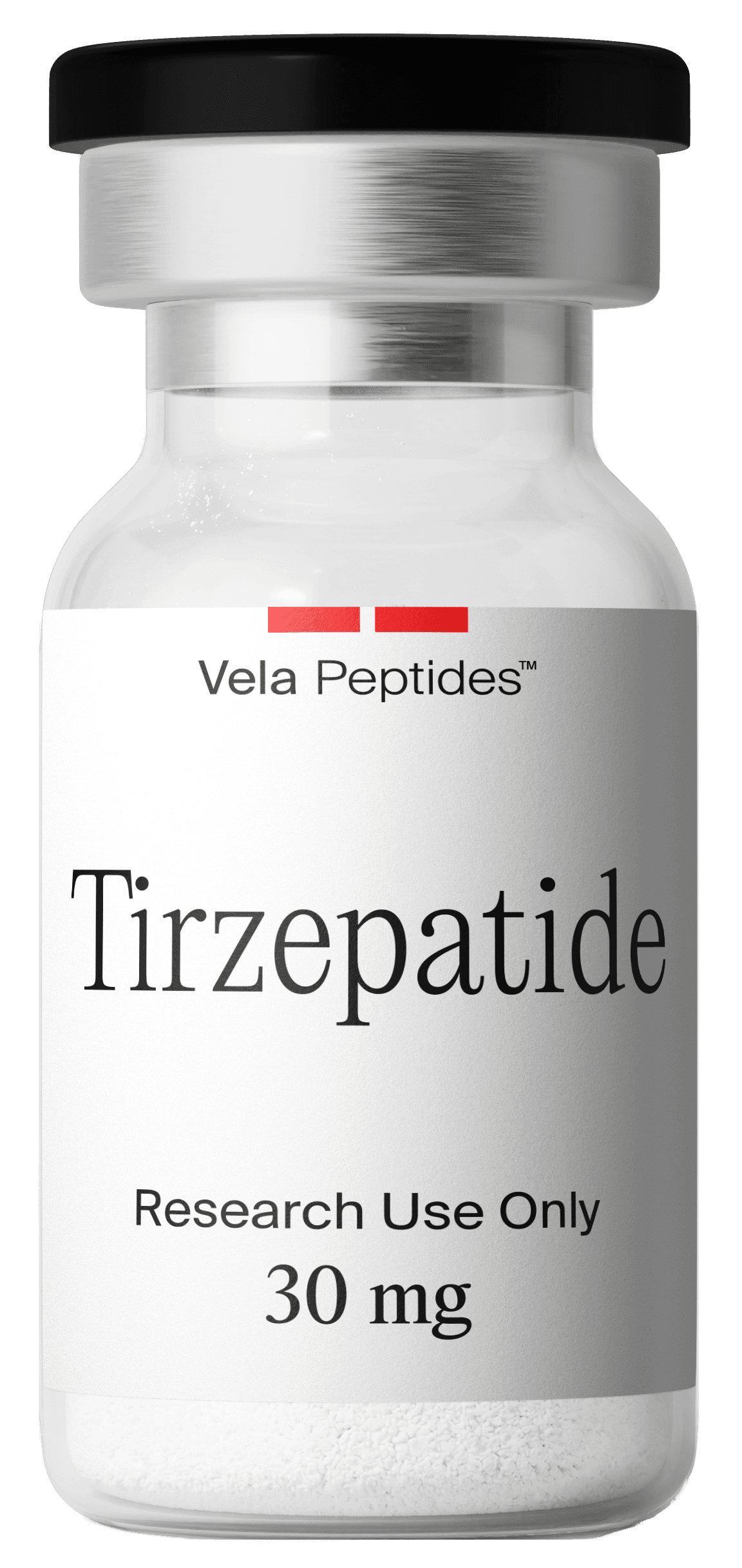
Tirzepatide 30mg
For in vitro research only
A synthetic 39-amino-acid dual GIP/GLP-1 receptor agonist supplied as a 30 mg lyophilized vial for research into incretin signaling, glucose-dependent insulin secretion, and energy-balance regulation.
Quantity
- Free shipping from $300
- Same-day shipping — order before 1 PM
- Secure payment
Promotion
Free 3 ml bacteriostatic water with every order.
Everything you need to start is included.
New
Advanced lab tests
Technical specification
- Molecular formula
- C₂₂₅H₃₄₈N₄₈O₆₈
- Molar mass
- 4813.527 g/mol
- Purity
- ≥99%
- Synonyms
- LY3298176, Mounjaro, Zepbound
- Solubility
- Water-soluble (reconstitute with bacteriostatic water)
- Organoleptic profile
- White to off-white lyophilized powder
- Composition
- Synthetic peptide — requires reconstitution
Key attributes
Kit contents
- 1 × Tirzepatide 30mg vial
- Tamper-evident flip-off cap
- Batch-tested for purity (≥99%)
- Lyophilized for stability during shipping
Each vial is intended for laboratory research use only and is not for human or veterinary use.
Research usage
How is Tirzepatide 30mg used in research?
Tirzepatide is investigated as a dual agonist of the glucose-dependent insulinotropic polypeptide (GIP) and glucagon-like peptide-1 (GLP-1) receptors, a design often described as a 'twincretin'. In preclinical models it is studied for its capacity to enhance glucose-dependent insulin secretion while attenuating glucagon output. Its engineered fatty-diacid moiety and amino-acid substitutions are examined for the extended half-life and once-weekly profile they confer in research systems. Investigators use it to probe incretin-receptor cross-talk, gastric-emptying dynamics, and central appetite-regulating pathways. The 30 mg vial supplies additional material for extended assay panels and higher working concentrations in laboratory settings.
Research reports that dual GIP/GLP-1 receptor co-agonism produces greater reductions in glycemia and body weight than selective GLP-1 activation in animal research models. In controlled clinical investigations, doses studied up to 15 mg weekly have been associated with substantial improvements in glycemic markers and reductions in body weight across the SURPASS and SURMOUNT programs. Preclinical studies describe enhanced insulin sensitivity, delayed gastric emptying, and reduced food intake following receptor activation. The 30 mg presentation is intended solely to provide more research material and higher working concentrations; it does not correspond to any characterized dose, and efficacy figures reported in the literature pertain only to the 5–15 mg range studied.
The complete safety and toxicological profile of tirzepatide has not been completely characterized. In the published literature, GLP-1-class agents are associated with dose-dependent gastrointestinal effects and injection-site reactions across the ranges studied. This material is for laboratory research use only and is not for human or veterinary use. It should be handled only by qualified personnel using appropriate protective equipment and good laboratory practices.
Recommended ratio
- 3 mL of bacteriostatic water per 30 mg vial
- Equivalent to 10 mg/mL (i.e. 1 mg per 10 units on a 100 U insulin syringe)
- Disinfect the vial stopper with an alcohol swab and let it dry.
- Inject the bacteriostatic water slowly down the inside wall of the vial, not directly onto the powder.
- Gently swirl — do not shake — until the solution is completely clear.
Unopened / before reconstitution
- Store refrigerated (2 °C – 8 °C), protected from light.
- For long-term storage, keep at −20 °C.
- Avoid repeated temperature fluctuations.
Reconstituted solution
- Store refrigerated (2 °C – 8 °C) and use within the research timeframe.
- Do not freeze the reconstituted solution.
- Keep protected from light and avoid repeated freeze-thaw cycles.