
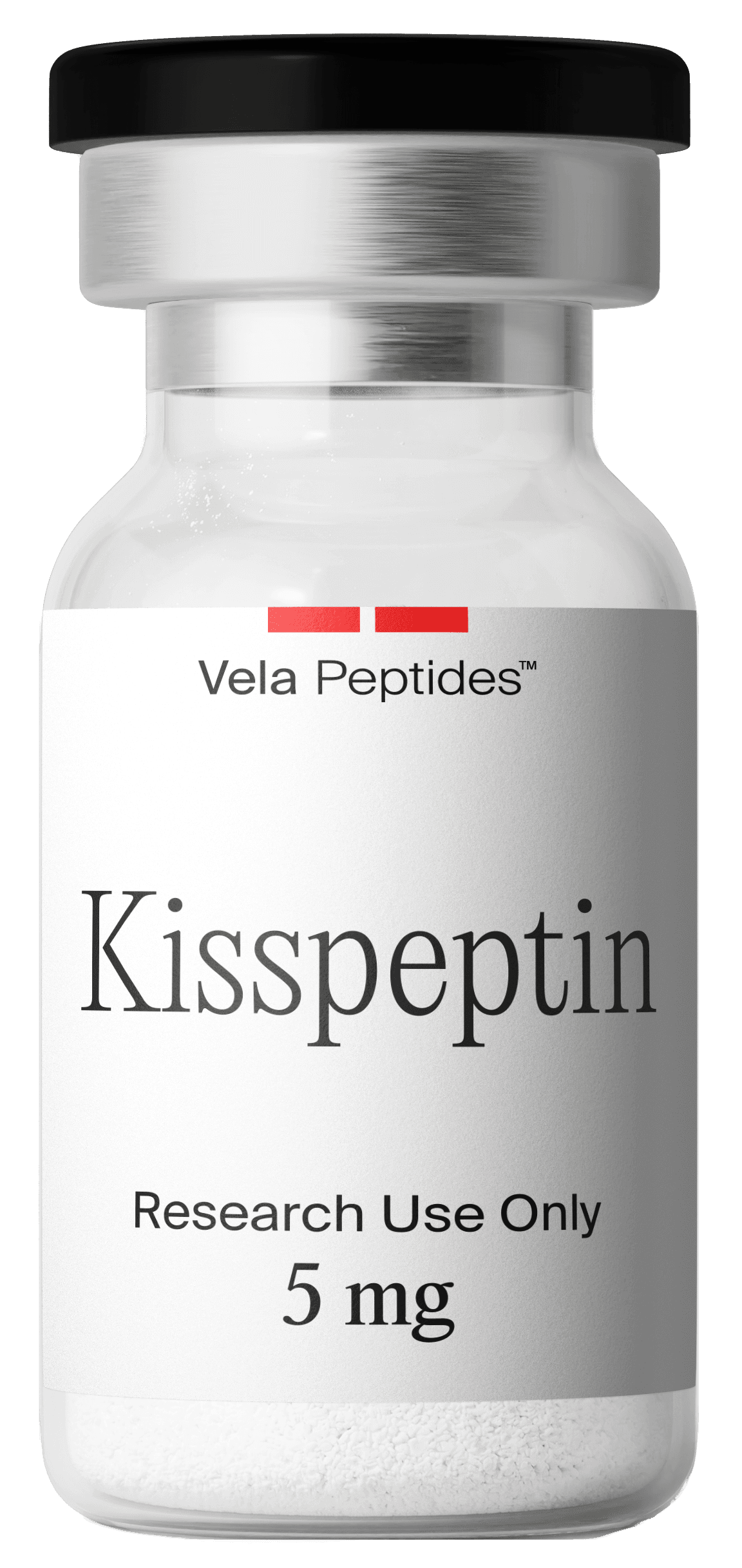
Kisspeptin 5mg
For in vitro research only
A 10-amino-acid C-terminal fragment of metastin supplied as a 5 mg lyophilized vial for research into KISS1R/GPR54 signaling, GnRH neuronal activity, and the hypothalamic-pituitary-gonadal axis.
Quantity
- Free shipping from $300
- Same-day shipping — order before 1 PM
- Secure payment
Promotion
Free 3 ml bacteriostatic water with every order.
Everything you need to start is included.
New
Advanced lab tests
Technical specification
- Molecular formula
- C₆₃H₈₃N₁₇O₁₄
- Molar mass
- 1302.4 g/mol
- Purity
- ≥99%
- Synonyms
- Kisspeptin-10, KP-10, Metastin(45-54)
- Solubility
- Water-soluble (reconstitute with bacteriostatic water)
- Organoleptic profile
- White to off-white lyophilized powder
- Composition
- Synthetic peptide — requires reconstitution
Key attributes
Kit contents
- 1 × Kisspeptin 5mg vial
- Tamper-evident flip-off cap
- Batch-tested for purity (≥99%)
- Lyophilized for stability during shipping
Each vial is intended for laboratory research use only and is not for human or veterinary use.
Research usage
How is Kisspeptin 5mg used in research?
Kisspeptin-10 is investigated as the endogenous ligand of the KISS1R/GPR54 receptor and as an upstream regulator of gonadotropin-releasing hormone (GnRH) neuronal signaling. In preclinical models, researchers study how the peptide activates KISS1R on GnRH neurons to modulate the pulsatile release that drives the hypothalamic-pituitary-gonadal axis. Its short decapeptide structure — the C-terminal fragment of metastin (kisspeptin-54) — makes it a common tool for probing receptor binding and downstream Gq/phospholipase-C signaling. Investigators also examine kisspeptin as a research probe for the neuroendocrine control of reproduction and puberty onset in animal models. Work in this area focuses on receptor pharmacology, signal transduction, and the peptide's role in the KISS1/GPR54 pathway.
Research reports that kisspeptin-10 binds KISS1R/GPR54 with high affinity and stimulates GnRH release in animal research models. In preclinical studies, administration has been associated with measurable changes in downstream gonadotropin signaling within the hypothalamic-pituitary-gonadal axis. Investigators note that the peptide's activity is relatively short-lived owing to rapid proteolytic processing of the decapeptide. Comparative research also characterizes differences between kisspeptin-10 and the longer kisspeptin-54 isoform in receptor engagement and signaling duration. These observations remain confined to laboratory and animal research contexts.
The safety profile of kisspeptin-10 has not been completely characterized and it should be handled only by qualified personnel using appropriate laboratory controls. Standard precautions for handling lyophilized peptides — including protective equipment and avoidance of inhalation or contact — apply. This material is supplied strictly for in-vitro and preclinical research and is not for human or veterinary use. Consult the applicable safety data before handling.
Recommended ratio
- 2 mL of bacteriostatic water per 5 mg vial
- Equivalent to 2.5 mg/mL (i.e. 0.25 mg per 10 units on a 100 U insulin syringe)
- Disinfect the vial stopper with an alcohol swab and let it dry.
- Inject the bacteriostatic water slowly down the inner wall of the vial.
- Gently swirl — do not shake — until the powder is fully dissolved and the solution is clear.
Unopened / before reconstitution
- Store refrigerated (2 °C – 8 °C), protected from light.
- For long-term storage, keep frozen at -20 °C.
- Avoid repeated temperature fluctuations.
Reconstituted solution
- Store at 2 °C – 8 °C and use within 2–4 weeks.
- Avoid repeated freeze-thaw cycles; aliquot if longer storage is required.
- Keep the solution protected from light.